Chief Mike Ozekhome and the Tali Shani Passport Controversy
Chief Mike Ozekhome and the Tali Shani Passport Controversy: Forged Documents and the Credibility of Nigeria’s Legal Profession.
When a senior and respected lawyer appears before a foreign tribunal bearing official-looking documents from his home country, the court is entitled to presume that those documents carry the authentic voice of the state. International litigation relies on that quiet presumption of trust. Without it, the recognition of foreign documents in international litigation would descend into chaos. But what happens when the document and the supposed voice of the state that speaks through it – turns out to be nothing more than an expertly crafted counterfeit?
That question lies at the heart of the extraordinary saga surrounding a modest house at 79 Randall Avenue in North London – allegedly bought in 1993 with Nigeria’s stolen funds by the now late army general Jerry Useni under the name “Tali Shani.” Decades later, the property is thrust into the centre of an attempted fraudulent transfer that has now spilled from a London tribunal into Nigeria’s criminal justice system.
What now demands closer scrutiny is not merely the attempted fraudulent transfer itself, but the role played by a very senior Nigerian lawyer, Chief Mike Ozekhome SAN, in what can only be described as a quiet but consequential battle of forgeries.
The Mystery of “Tali Shani”
At the centre of the London proceedings was a deceptively simple question: who was “Tali Shani”? The tribunal confronted two competing identities. On one side stood a non-existent female claimant, “Ms. Tali Shani,” whose existence was propped up by forged identity records including a forged Nigerian National Identification Number (NIN) slip, fabricated family witnesses, and a trail of other documents later exposed as fraudulent. On the other side was a man presented as “Mr. Tali Shani,” who appeared in person, tendered a Nigerian passport, and was advanced as the registered owner who had transferred the property to Chief Ozekhome.
Chief Ozekhome’s legal strategy was methodologically brutal – deploying investigations and confirmations from Nigerian state institutions to dismantle the bogus female claimant standing in the way of his claim to the property. Using his influence, he obtained documentation from agencies including the Nigerian Police and the National Identity Management Commission to demonstrate, (and correctly), that “Ms. Tali Shani” was a sham, and that the documents tendered in proof of her identity were fraudulent. These institutional confirmations played a decisive role in exposing one side of the forgeries – the opposing side.
But the evidentiary contest did not end there as it shifted to the Ozekhome side of the case. The authenticity of “Mr.” Tali Shani’s passport presented by Ozekhome to facilitate the property transfer became pivotal. When Dylan Conrad Kreolle, a lawyer opposing the transfer and alleging that the passport was fraudulent, wrote to the Nigeria Immigration Service (NIS) seeking verification, there was no response from the NIS.
However, when Chief Ozekhome sought confirmation from the same agency that the passport was genuine, a letter emerged bearing what appeared to be the authority of the NIS. The letter purportedly signed by one Abdulkadir Lawal, an Assistant Legal Adviser of the NIS, on behalf of the Nigerian Comptroller General of Immigration, confirmed the passport’s authenticity and even attached a certified biodata page.

Exhibit CMO21: Letter from Chief Ozekhome to Nigeria Immigration Service purportedly seeking authentication of Mr Tali Shani passport

Exhibit CMO22: A purported NIS letter confirming the authenticity of the Tali Shani passport produced by Chief Ozekhome and admitted as evidence by the London Tribunal
The significance of this letter and its authentication in the proceedings cannot be overstated. The presiding judge, Ewan Paton, accepted the authentication and accorded it considerable weight. He noted that, “[u]nlike the fictitious “Ms. Tali Shani”, a man going by the name of Mr. Tali Shani exists and gave evidence before me in that name. A certified copy of an official Nigerian passport was produced …, stating that Mr. Tali Shani was born on 2nd April 1973. I do not have the evidence, or any sufficient basis, to find that this document – unlike the various poor and pitiful forgeries on the side of the “Applicant” – is forged” [Emphasis added].
What appeared authentic in the moment to Judge Paton would later unravel, revealing a fabrication that had slipped past judicial scrutiny under the cover of a purported NIS official certification.
While the purported confirmation from the NIS did not prove ownership of the property, it did something critically important: it conferred procedural credibility. It prevented the tribunal from rejecting the identity document outright. It gave Chief Ozekhome a foothold of authenticity on a narrow but decisive evidentiary point. And in doing so, it helped facilitate an attempted transfer built on a contested identity.
Then the controversy resurfaced in Nigeria
Yet the story did not end in London. Months later, the controversy resurfaced in Nigeria – this time not as a property dispute but as a criminal matter. In January 2026. Nigeria’s Independent Corrupt Practices and Other Related Offences Commission (ICPC) filed criminal charges against Chief Mike Ozekhome SAN relating to the controversial “Tali Shani” passport that had surfaced in the London proceedings. Yet the most startling revelation in the charge sheet did not lie in the allegations alone. It lay in one of the exhibits attached to the case file: a letter from the Nigeria Immigration Service addressed to the Chairman of the ICPC.
The letter stated, in clear and unequivocal terms, that the very Tali Shani passport accepted as authentic by the London tribunal was in fact fraudulent, and that no corresponding holder record exists in the NIS database. In simple terms, the passport that had earlier travelled into a London courtroom carrying the apparent authority of the Nigerian state was now being described by the Nigerian state itself as fraudulent.
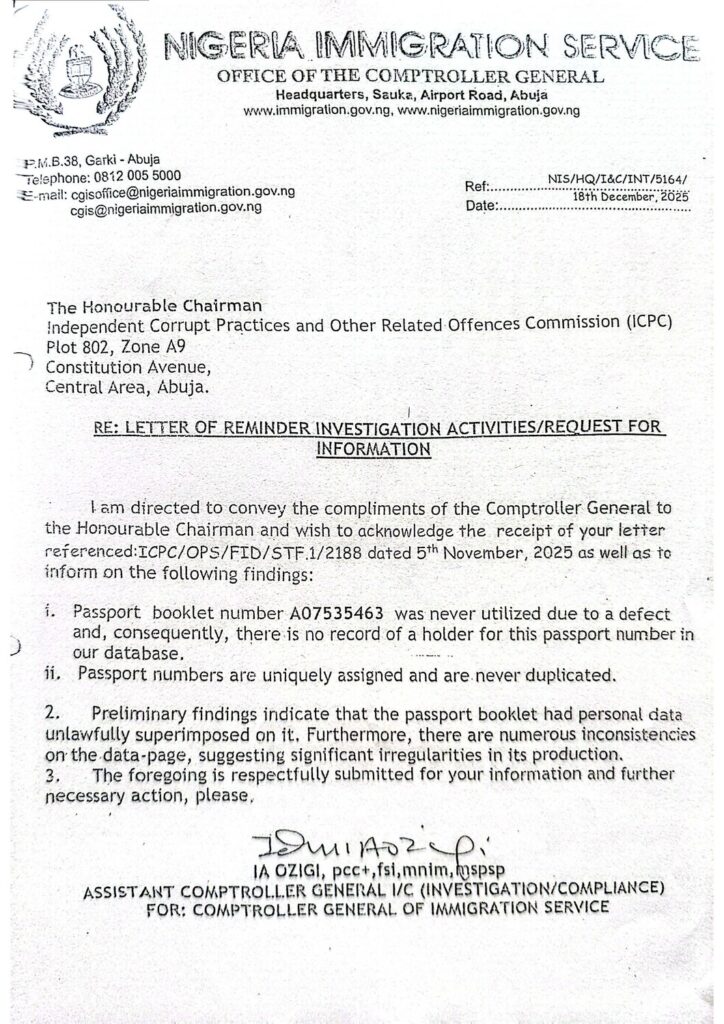
A letter from the Nigeria Immigration Service denying the validity of the Tali Shani passport
A comparison of the NIS letter tendered by Ozekhome at the London tribunal with the later letter issued by the NIS to the ICPC reveals striking differences – the formats differ and the official letterheads are not identical.
The Real Casualty: Credibility
This contradiction raises questions that reach far beyond the fate of one London property. If the Tali Shani passport was indeed fraudulent, then the question is no longer simply about a forged document; it is about how such a document found its way into the evidentiary record of a foreign tribunal under the authority of a senior member of the Nigerian Bar. How was the passport obtained? Who facilitated its production? And what role, if any, did Ozekhome play in the procurement and use of a document now alleged to be fraudulent? These are not idle curiosities. They go to the heart of the integrity of both the Nigeria’s legal profession and the institutions whose documents courts around the world are expected to trust.
Senior Advocates of Nigeria occupy the highest rank of the Bar. They are meant to embody the profession’s commitment to integrity and candour. Although no criminal forgery has been proven against Chief Ozekhome, allegations that a senior lawyer may have relied on a fraudulent passport and forged institutional confirmations in foreign proceedings inevitably cast a shadow far beyond the individual. They reach the reputation of the legal profession itself.
Foreign courts depend on the authenticity of documents issued by national authorities. When those documents are forged – or when state authority is impersonated – the credibility of every document originating from that jurisdiction begins to erode.
A forged passport is troubling enough. But a forged institutional confirmation – one that appears to speak for the state itself – strikes at something deeper: the fragile trust that allows legal systems across borders to recognize each other’s official acts.
The Tali Shani saga therefore presents Nigeria with a moment of uncomfortable reflection. If the allegations surrounding the passport are accurate, then what unfolded in the London tribunal was not simply a property dispute involving fabricated identities. It was a case in which the appearance of Nigerian state authority was allegedly invoked – perhaps even fabricated – by an individual in aid of a contested legal claim abroad.
For a profession that prides itself on honour and integrity, such allegations cannot be brushed aside. The credibility of the Nigeria legal profession rests not on silence but on accountability. And when the highest ranks of the profession become entangled in allegations of forged documents in a foreign court, the question that confronts Nigeria is no longer simply legal. It is institutional.
For in the end, the most enduring casualty of the Tali Shani passport saga may not be the ownership of 79 Randall Avenue. It may be the credibility of the Nigerian state itself.
Prof. Gideon Christian teaches professional ethics at the Faculty of Law, University of Calgary, Alberta, Canada. He is the recipient of the 2026 CBA (Alberta) and Law Society of Alberta Distinguished Service Award. www.gideonchristian.ai